
2026 IRS Mileage Deduction: Two Rates. One Year-End Checklist.
The tax year ends December 31. Before filing your 2026 return in 2027, organize the business miles you actually drove—and be ready to support them if the IRS asks.
MileFree features shown in this article
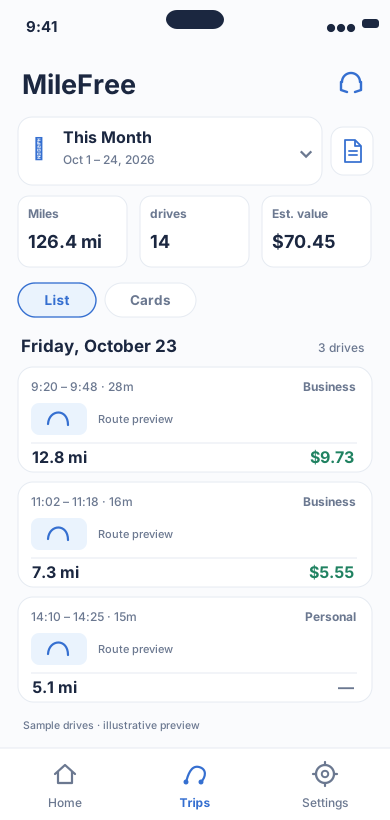
Date range, miles, drives and reviewable trip history.
Flutter UI: HistoryScreenOpen larger preview ↗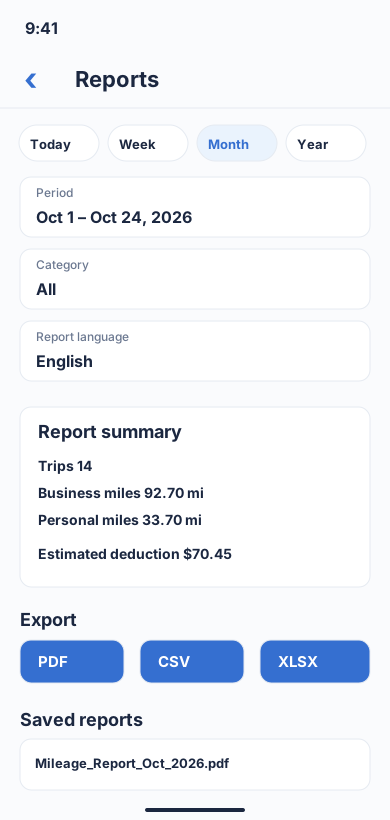
Choose a period and category, review business/personal totals, then download a report in PDF, CSV or XLSX format.
Flutter UI: ReportBuilderScreenOpen larger preview ↗Illustrative previews based on the app interface, with example data. These are not actual iPhone screenshots; the design may change. Preview text is in English.
2026 IRS business mileage rates
2026 deduction = (January 1 – June 30 business miles × $0.725) + (July 1 – December 31 business miles × $0.76)
Calculate your potential 2026 mileage deduction
Enter eligible business miles for each half of the year. This estimates a deduction, not a tax refund. Your eligibility and filing method matter.
Example: 9,000 business miles
Imagine a delivery driver records 4,000 eligible miles from January to June and 5,000 from July to December:
| Period | Business miles | Potential deduction |
|---|---|---|
| January 1 – June 30 | 4,000 | $2,900 |
| July 1 – December 31 | 5,000 | $3,800 |
| Total | 9,000 | $6,700 |
That is $6,700 in deductible vehicle costs—not $6,700 paid back by the IRS. A deduction may reduce taxable income, not dollar-for-dollar tax owed.
Which miles may count?
Business trips to customers, deliveries, trips between work locations, and supply or parts pickups can qualify when they are genuinely business-related. Personal errands and ordinary commuting generally do not. Special rules can apply when your home is your principal place of business. Keep business, personal, and commuting miles separate.
What should a defensible IRS mileage log contain?
IRS Publication 463 calls for timely, accurate records. For each business use, record the date, destination, business purpose, and distance. Also know your total vehicle mileage for the year and retain evidence that supports the log.
- Date and miles driven for the business trip
- Destination or route and a clear business purpose
- Yearly vehicle mileage, with odometer readings to help reconcile totals
- Supporting documents when available: delivery history, job calendar, invoices, parking or toll receipts
A digital log is acceptable when it contains adequate information. Record drives close to when they happen; do not invent trips or estimate missing mileage without support.
Your year-end mileage checklist—before December 31
- Split the year
Separate January 1–June 30 trips from July 1–December 31 trips. July 1 starts the higher business rate.
- Review missing drives
Compare your mileage history with completed deliveries, customer appointments, and parts runs. Correct classifications using real evidence.
- Reconcile the odometer
Record the vehicle odometer near year-end and keep opening/closing readings or other reliable annual-mileage evidence.
- Check business vs. personal
Keep commuting and personal trips out of your claimed business-mile total.
- Save supporting costs
Business parking and tolls may generally be deductible in addition to the standard mileage rate; retain receipts. Do not add gas, repairs, or insurance again under that same method.
- Export and back up
Save the detailed trip log and a yearly summary where you can retrieve them. Check that both date ranges and their totals are visible.
Standard mileage or actual vehicle expenses?
Eligible taxpayers generally choose either the standard mileage method or the business portion of actual vehicle costs, subject to IRS restrictions and earlier method choices. You cannot deduct the same gasoline, repairs, insurance, or depreciation twice. Compare the methods using your records, or consult a tax professional before filing.
What if the IRS asks for proof?
Be ready to show your dated mileage log and supporting business records. IRS guidance says timely records carry more weight than a reconstruction months later. Inadequate proof can lead to a reduced or denied deduction. Keep supporting records generally at least three years after filing; some situations require longer.
Frequently asked questions
Can I multiply all 2026 business miles by 76 cents?
No. The 76-cent rate applies only to eligible business miles driven July 1–December 31. Earlier miles use 72.5 cents.
Is the estimated deduction my tax refund?
No. A deduction may reduce taxable income; actual federal and state tax effects depend on your situation.
Can W-2 employees deduct all unreimbursed work miles?
Generally no for federal income tax purposes; limited exceptions exist. Employees can ask about employer reimbursement and should check applicable rules.
Does a mileage app guarantee an IRS-approved deduction?
No. You still need to review the records, classify trips correctly, and follow IRS eligibility and recordkeeping rules.
Keep your mileage organized with MileFree
MileFree helps automatically record iPhone trips, review driving history, separate business and personal trips, and prepare mileage reports. It is in public beta on TestFlight. Your core trip data stays on your phone. No account, subscription, trip cap, or hidden fee.
Stop paying for what should be free.Try the free iPhone public beta →Official sources
- IRS standard mileage rates ↗
- IRS Announcement 2026-11 (July adjustment) ↗
- IRS Publication 463 (records and vehicle expenses) ↗
General U.S. tax information, not individual tax advice. Tax eligibility, calculation methods, and retention requirements depend on the facts. Check current IRS rules or a qualified tax professional.