
I started looking closely at mileage apps because the same pattern kept appearing: an app looks free at first, you begin using it, your daily routine starts depending on it — and then the useful part of the product turns into a subscription.
I understand why software companies charge money. Development costs money. Support costs money. Servers cost money. There is nothing wrong with selling a useful product.
What bothered me was the experience from the user's side. You are invited in with “free,” you build a habit, and later you discover a limit, a premium tier, a monthly payment, or a feature you expected to have that is only available after upgrading.
“Free” can mean very different things.
One app may be free for a limited number of automatically detected drives. Another may keep manual tracking free but charge for unlimited automation. Another may reserve advanced reporting or other convenience features for a paid plan.
That is a legitimate business model. But it is not the product model I wanted for MileFree.
If you are a contractor, technician, delivery driver, salesperson, real-estate agent or self-employed worker, mileage tracking is not a novelty you use twice a month. It can become part of every working day. Once that happens, a small recurring software charge becomes another permanent business expense.
The market shows how quickly “free” can become limited.
As of October 2026, Everlance's Basic plan includes 30 automatically detected trips per month; unlimited automatic trip detection is included in paid Starter and Professional plans. MileIQ's Basic plan allows up to 40 drives per month, while unlimited drives require a subscription.
MileIQ also announced a subscription price increase in 2026. That is not a criticism of MileIQ — prices change, companies evolve and paid products have every right to change what they charge. But it illustrates the exact dependency I wanted to avoid with MileFree: once an app becomes part of your workday, future pricing is no longer fully under your control.
That is one of the reasons I decided to build MileFree.
I wanted to answer a very simple question: why should basic mileage tracking require another monthly subscription?
The iPhone already has GPS. It already has motion sensors. The user already owns the phone. A mileage tracker still takes serious engineering to make reliable, but the basic act of recording your own drives, reviewing your history, separating Business and Personal trips and seeing your mileage totals should not have to become another recurring bill.
So MileFree is being built around the opposite idea: keep the mileage app simple, keep core trip data private, and make the whole mileage-tracking feature set free without Premium or subscription tiers.
MileFree features shown in this article
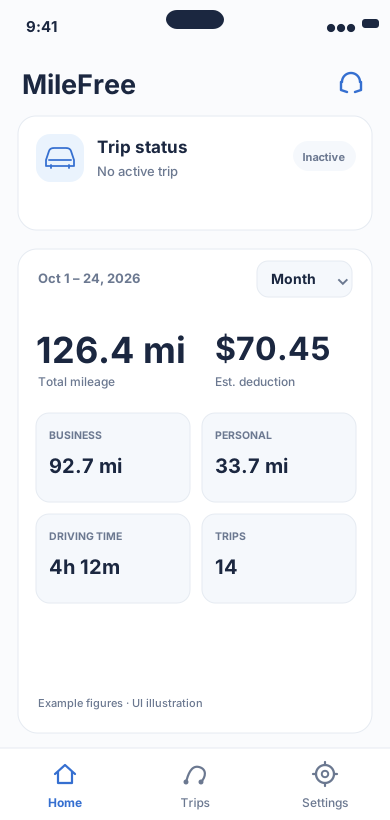
Current mileage and tracking status.
Flutter UI: HomeScreen / SummaryCardOpen larger preview ↗Illustrative previews based on the app interface, with example data. These are not actual iPhone screenshots; the design may change. Preview text is in English.
The MileFree promise: the entire mileage app will be free.
This is the important part. “Free” does not mean a seven-day trial. It is not intended to mean a tiny automatic-trip allowance that becomes unusable for somebody who actually drives for work.
MileFree is planned as a completely free app, not a limited free tier: no Premium/Pro, subscription or monthly trip cap. Read the full official announcement →
That includes automatic and manual trip recording, trip history, Business / Personal classification, mileage summaries and odometer features. The purpose is straightforward: you should be able to use MileFree as an actual mileage tracker without being forced into a monthly payment.
I do not want somebody to use MileFree for months and then discover that the basic workflow they depend on suddenly requires a subscription.
Completely free mileage tracking, not a paid upgrade.
No hidden trip limit designed to push regular drivers into a paid plan. No surprise mileage paywall after the app becomes part of your routine.
The architecture also matters if you want a product to stay free.
One reason software becomes expensive to operate is that more and more user data is moved to cloud infrastructure and continuously processed on company servers.
MileFree currently takes a simpler approach for its core records. Core trip, odometer and preference data is stored locally on the iPhone, and normal use does not require a MileFree account or cloud synchronization of the main mileage history.
That is good for privacy, but it also fits the product philosophy: do not build unnecessary infrastructure just so the user can record data that belongs to them.
Your driving history can reveal customer addresses, work patterns and repeated locations. Keeping the main record local whenever possible is not just cheaper architecture. It is the safer architecture for this kind of product.
Free is meaningless if the tracker is not reliable.
I also do not want “free” to become an excuse for a weak product. A mileage tracker has one basic responsibility: record the driving you expect it to record and give you a history you can understand later.
That means working on the hard parts: background behavior on iPhone, motion detection, trip persistence, automatic start and stop behavior, manual backup controls and clear history.
No honest GPS app can promise a perfect location signal under every possible phone condition. But MileFree can be built with reliability as a core requirement instead of treating it as something to fix after launch.
A different business decision
Maybe the easiest way to monetize a mileage tracker is to get users accustomed to it and then charge for unlimited use. That model already exists.
I wanted MileFree to make a different promise.
Your miles are yours. Your history is yours. And the core tool you use to track them should not require another monthly bill.
Product status: MileFree is still being prepared for its first public iPhone App Store release. The iPhone public beta is available through Apple TestFlight, but the first App Store release is still being prepared.
That is why MileFree exists.
Easy. FULL FREE. Safe. Reliable.