
A short parts run is easy to forget. So is the return visit to finish a job, the trip between two customer addresses or the drive to give an estimate. For someone who works on the road, those small journeys can be a substantial part of the week.
This guide is for 1099 independent contractors, sole proprietors, freelancers, solo service professionals and self-employed workers who use a car for business. It explains what to capture, where commuting rules matter and how a free iPhone tracker can make recordkeeping easier. It is not a promise that every recorded trip qualifies for a tax deduction.
Does “1099 contractor” mean you can deduct every mile?
No. “1099 contractor” is a common name for an independent worker who may receive Form 1099-NEC reporting nonemployee compensation. The form reports payments; it does not automatically make your driving deductible or determine your worker classification. See the IRS explanation of independent-contractor forms.
People who may benefit from keeping a business mileage log include electricians, plumbers, appliance repair technicians, handymen, painters, cleaners, installers, inspectors, mobile detailers, photographers visiting clients and delivery contractors. A solo 1099 worker, a sole proprietor or the owner of a single-member LLC may all need records of client-related driving, but the business entity and tax treatment are separate questions.
The practical rule is simple: record the trip and its purpose first; verify eligibility separately. An app's Business label does not replace tax rules or professional advice.
What does a contractor's driving day really look like?
Imagine an appliance technician with two appointments. First comes an estimate, then a supplier stop for a replacement part, then the second customer, followed by a personal grocery stop. Treating the whole day as one business trip would hide an important distinction.
Independent contractors also have unpaid estimates, callbacks and repeat supply runs. Keep each leg visible so you can review what actually happened instead of guessing from a weekly odometer total.
What should a 1099 contractor mileage log include?
For U.S. vehicle-expense records, the IRS describes the date, business destination, business purpose, miles driven for each business use and the vehicle's total miles for the year. A timely log is stronger than an estimate reconstructed months later. Supporting job records or invoices may be useful when appropriate. Read IRS Publication 463, Recordkeeping.
Here is an illustrative example, not measured MileFree data and not a determination of deduction eligibility:
| Date | Trip and business purpose | Distance | Classification to review |
|---|---|---|---|
| Nov 6 | Customer A → supplier, replacement part pickup | 5.4 mi | Potential business |
| Nov 6 | Supplier → Customer B, service appointment | 9.8 mi | Potential business |
| Nov 6 | Customer B → grocery store, personal errand | 2.1 mi | Personal |
| Nov 7 | Home → regular work location | 7.6 mi | Check commuting rules |
A route captured with GPS still needs its business purpose checked. A recorded distance is not, by itself, an IRS-approved tax record. You may also need vehicle mileage and supporting documentation outside the app, depending on your filing method.
MileFree features shown in this article
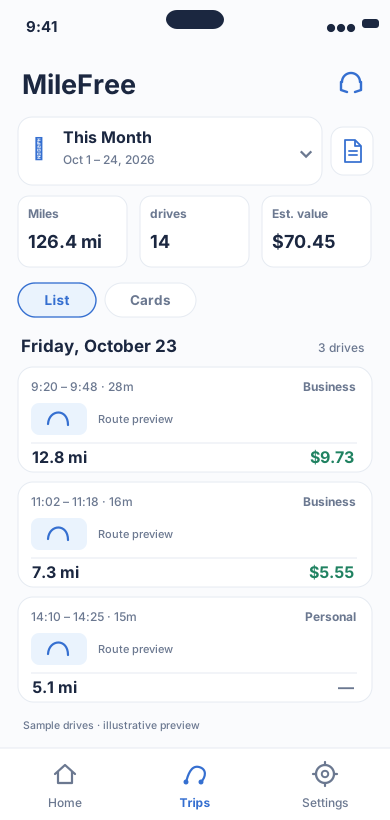
Date range, miles, drives and reviewable trip history.
Flutter UI: HistoryScreenOpen larger preview ↗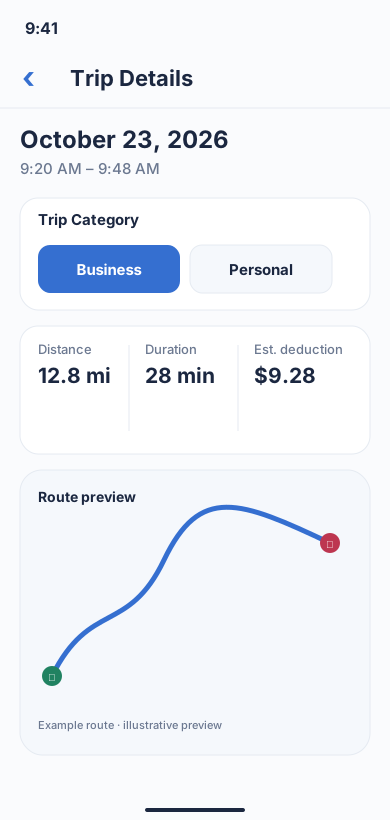
A real MileFree workflow: classify one recorded trip as Business or Personal and review distance, duration and estimated value.
Flutter UI: TripScreenOpen larger preview ↗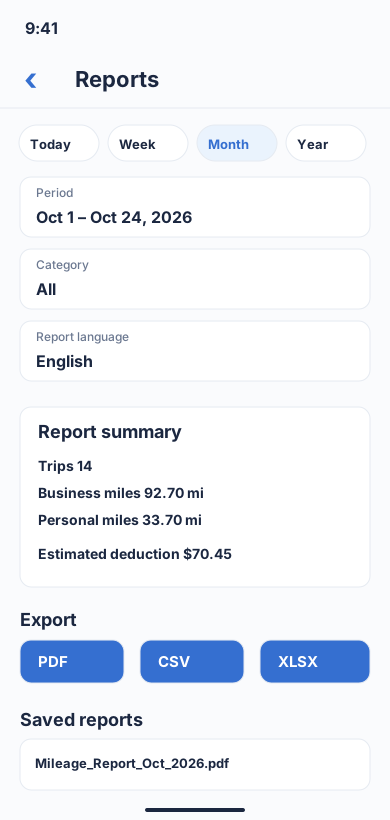
Choose a period and category, review business/personal totals, then download a report in PDF, CSV or XLSX format.
Flutter UI: ReportBuilderScreenOpen larger preview ↗Illustrative previews based on the app interface, with example data. These are not actual iPhone screenshots; the design may change. Preview text is in English.
Are home-to-client and job-site miles deductible?
Sometimes, but not automatically. Ordinary travel between home and a regular work location is generally considered commuting and is not deductible. Travel between business locations or client appointments may be treated differently. Certain temporary work locations and a qualifying home office that is a principal place of business can change the answer.
Example: the drive from a client's home to a parts supplier for that job may be business transportation; a normal drive from home to your regular workplace may be commuting. Because the facts matter, don't set all home-to-first-job and last-job-to-home trips to Business without review. The IRS commuting and transportation guidance covers the exceptions.
2026 IRS business mileage rates for independent contractors
The IRS changed the 2026 standard business mileage rate midyear. For eligible business use, the published rates are:
| Trip dates | Standard business rate |
|---|---|
| January 1 – June 30, 2026 | 72.5¢ per mile |
| July 1 – December 31, 2026 | 76¢ per mile |
For qualifying trips in January–June.
400 × $0.76 = $304For qualifying trips in July–December. Combined potential deduction: $594, not a $594 cash refund or automatic tax saving.
Use the rate that applies to the date of a qualifying trip, not one rate for the whole year. The standard-mileage method also has eligibility and consistency conditions; it is not always interchangeable with the actual-expenses method. Verify with the official IRS rate table and IRS Tax Topic 510.
How MileFree helps you organize independent-contractor mileage
MileFree is an iPhone mileage tracker designed for people who drive to work, not people who want to spend the evening typing routes into a spreadsheet. Its core workflow is straightforward:
Enable automatic tracking with the required iPhone permissions, or use manual Start and Finish when you want direct control.
Review customer stops, material pickups and callbacks while the details are still fresh.
Keep Business and Personal drives separate; recheck commute and mixed-purpose trips.
Check mileage totals for the dates you need and keep any additional tax records required for your situation.
You can learn more about the business mileage tracking workflow and the appliance repair example. MileFree helps you organize drives; it does not file Schedule C, calculate your final taxes or certify an IRS deduction.
Privacy matters when your routes lead to customers
Your mileage history may reveal home addresses, customer locations and work patterns. The current MileFree design stores core trip, odometer and preference data locally on the iPhone, without requiring a MileFree account or cloud sync for those core records.
Automatic trip capture depends on iPhone permissions, device conditions and available location signals. No mileage app can guarantee that every trip will always be recorded perfectly. Review the history regularly and use manual controls when needed.
What “Full Free” means for a 1099 mileage tracker
Some services let you download an app for free but restrict the number of trips, reporting or automatic tracking behind a paid subscription. That's free to install, not necessarily free to use for an entire contracting business.
MileFree follows a Full Free philosophy: the planned public iPhone app will not require Premium, subscriptions, hidden mileage fees or monthly trip caps for its core tracking, classification, history and mileage summaries. The public App Store release is still in preparation; the public iPhone beta and its current availability are described separately.
Track work miles. Not another monthly bill.
Made for independent contractors who need a simple, private and reviewable mileage history. No invented “IRS-certified” promise and no surprise core mileage paywall.
A 5-minute weekly review for solo contractors
Compare your trip history with customer appointments, callbacks and parts receipts.
Don't claim a grocery trip or another personal detour as business simply because it happened during the workday.
Check commuting, home-office and temporary-location rules instead of assuming.
Keep the trip purposes, total annual vehicle miles and other evidence your tax situation requires.
Questions 1099 workers ask about mileage tracking
Do I need to receive a 1099-NEC to keep a business mileage log?
No. The need for records depends on business use and your tax circumstances, not whether a particular customer sent you a form. The IRS describes independent-contractor status separately from the information return.
Can one app track both business and personal driving?
Yes. MileFree keeps both types of trips in a reviewable history and lets you classify them. Classification is your recordkeeping decision; it does not automatically make the miles deductible.
Is mileage tracking enough to claim the deduction?
Not on its own. Your log should be timely and accurate, document business purpose and be supported by other records when required. IRS rules govern what qualifies.
Is MileFree already available in the App Store?
The first public App Store release is still being prepared. The project offers public iPhone beta testing through TestFlight, subject to current invitation availability. See the MileFree beta page for the latest access details.